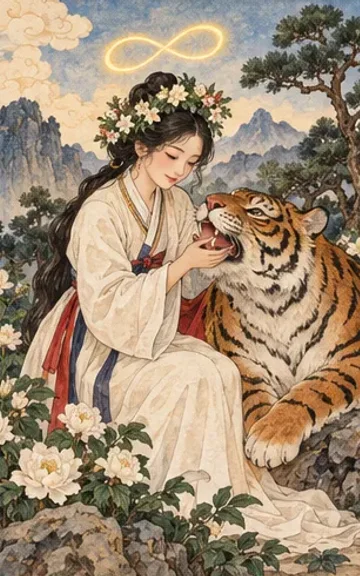
Strength
This is the quiet courage to guide situations with warmth rather than force. In the end, patience wins out over pressure, even when the struggle feels long.
Your confidence may dip for a while, or strong emotions could take the lead and leave you feeling shaky.
The card's advice: A steady attitude beats a loud voice.
Strength: reading the picture
The tiger's mouth is open wide enough to show its teeth, and resting against it are a woman's bare hands. She smiles, eyes almost closed, wearing a crown of white blossoms and a cream hanbok with a red ribbon tie. The tiger lies on a rock, paws loose, resting rather than ready to spring. It's a minhwa tiger, from Korean folk painting, where tigers often guard a household and chase off bad luck, so what she's calming could end up on her side. White peonies bloom in front, a bent pine behind. Above her floats the loop of light the Magician also has, but where he works with his hands, she works with patience.
Strength in love, work and money
- Love and relationships
Even when you argue, a generous response rather than raised voices can actually deepen the bond. Understanding their clumsy side and giving them time becomes your greatest charm now.
- Work and study
Difficult people or tricky tasks start to untangle when you meet them calmly. Steady persistence, rather than one big push to finish everything at once, is what builds your skill.
- Money
Instead of forcing down the urge to buy, gently ask yourself why you want it, and impulse purchases shrink. Patiently saving a little at a time pays off with a reassuring result.
Home two hours past curfew
At 1:10 a.m., the front door finally opened. A 47-year-old dad of two teenagers had spent two hours rehearsing what he would yell. He'd drawn Strength while he waited, and what stuck with him was that the woman doesn't strike or chain the tiger. He knew that when he came in loud, his son just got louder. So he said only, 'I'm glad you're home. We'll talk at breakfast,' and went to bed. In the morning, over eggs, they set a new rule together, and his son actually explained where he'd been.
Questions to ask yourself after drawing Strength
- When your own tiger, whether anger, appetite or impatience, opens its mouth, do you usually hit it or calm it?
- Who or what needs you to keep your hand there even though you're nervous?
- If the force you're trying to tame were well trained, how might it start protecting you instead?
Strength as a yes or no
Yes Patience and warm courage win in the end with this card, so given some time, the outlook is positive.
Easy to confuse with The Chariot
Both show a person managing powerful animals, so their meanings get swapped in memory. The Chariot's general stands armored, driving two haetae toward a goal: outward force, speed, winning. The woman in Strength has no armor and no weapon, only her hands on the tiger, earning its trust over time. Pushing toward a target is the Chariot. Holding steady and soothing is Strength.
A common misreading of Strength
Some read it as a signal to push hard. The picture says the opposite: she rests her hands on the tiger instead of pinning it down, so the strength here comes from persistence and kindness, not muscle or volume. In a conflict, it points to outlasting, not outshouting.
Symbols in Strength
The infinity sign of light above the woman's head says inner strength flows on without end, and her crown of flowers shows gentleness and vitality. She strokes the beast's mouth softly instead of forcing it shut, showing that even wild instincts can be tamed with warmth.
How we drew Strength
- Kept from the 1909 card
the infinity sign of light overhead, the flower crown, the woman gently stroking the beast's mouth
- What we changed
A minhwa tiger (the tiger of Korean folk painting) takes the lion's place. In minhwa folk painting the tiger stands for courage and protection. The meaning of guiding gently instead of by force stays the same.