Death
One chapter closes and a new one opens with this card. It isn't an ending to fear, but a needed clearing out that makes space for what comes next.
Holding on to what should end can slow down the change that's waiting for you.
The card's advice: Let go of one thing you need to release.
Death: reading the picture
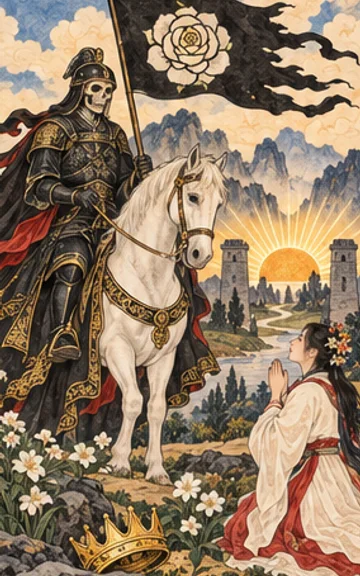
A white horse walks to the right, carrying a skeleton in black armor and a red cape. The rider's tall pole flies a black flag with one large white rose. In the horse's path, a woman in hanbok, traditional Korean dress, kneels with palms together and looks up. Older versions crowd the ground with fallen figures; here there is only her, plus a gold crown lying ownerless among white flowers at the lower left. Rank doesn't slow the horse. Now look farther back. Past the winding river, the sun rises between two towers. The front is an ending, the back a beginning, and the rider is passing between them.
Death in love, work and money
- Love and relationships
A long-running chapter in a relationship may close, or your current bond could take on a completely new shape. Clearing away old wounds and lingering attachment makes room for something deeper.
- Work and study
This is a turning point for ending work that doesn't fit, or old methods, and moving to a new stage. Instead of fearing the ending, decide what to set down, and the road ahead grows lighter.
- Money
It's a good time to boldly cancel subscriptions you pay out of habit and expenses that no longer serve you. Once you've cleared out your spending patterns, building new habits gets much easier.
Clearing out Mom's house after her move
Three weeks after her mother moved into assisted living, a 52-year-old daughter stood in her childhood home with a stack of flat boxes and couldn't tape the first one. Every drawer felt like a vote on whether the old life had mattered. She drew Death and found herself looking at the sunrise between the towers more than the skeleton. That night she filled one box with things her mother would want in her new room, photographed the rest, and booked a donation pickup. The house was ending. Her mother wasn't, and that box made the difference visible.
Questions to ask yourself after drawing Death
- Which title, role or routine are you still wearing like that dropped crown, even though its season is over?
- If you look past the rider to the sunrise, what's the first small thing you can picture on the far side of this ending?
- What skill, friendship or lesson from this stretch is worth packing up and taking with you?
Death as a yes or no
Maybe Things are hard as they stand, but if you clear out the old and change, a new beginning can follow.
Easy to confuse with The Tower
Both deal with things ending, but at different speeds. The Tower is a lightning strike: everything goes at once, and there's no time to pick what falls. Death is a horse at a walk. You can see it coming, and you get to decide how you meet it. If the change arrived without warning, think Tower; if you watched it approach, think Death.
A common misreading of Death
The most common worry is that this card predicts an actual death or a serious illness. In the traditional reading it points to the close of a phase, a relationship or a way of doing things. The skeleton isn't a threat. It shows, without softening, that endings reach everyone.
Symbols in Death
The armored skeleton knight on a white horse is the change that reaches everyone, and the black banner with a white rose holds new life within the ending. The sun rising between two towers promises tomorrow, while the fallen crown and the praying figure show all are equal before change.
How we drew Death
- Kept from the 1909 card
the armored skeleton knight on a white horse, the black banner with a white rose, the sun rising between two towers, the crown on the ground, the person with hands joined
- What we changed
Instead of the fallen king, bishop and child, the scene is reduced to a dropped crown and a single woman in hanbok with her hands joined.