The Hanged Man
Pause for a moment and look from a different angle, and the answer starts to appear. Waiting is not wasted time here; it is an important part of the process too.
You may be holding on for no real reason, or sacrificing yourself again and again.
The card's advice: Turn the problem upside down, and a path appears.
The Hanged Man: reading the picture
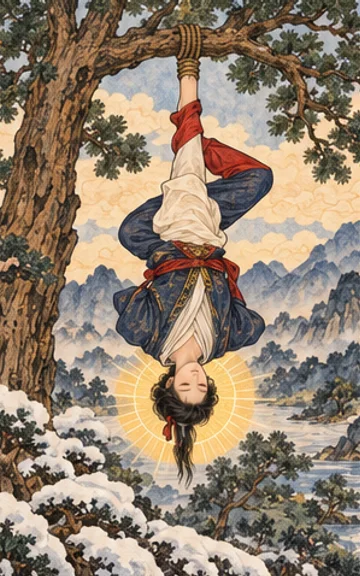
Tilt your head and the picture almost rights itself. A rope wraps a thick pine branch, and from it a figure hangs by one ankle, head down. The free leg folds behind the bound one in the shape of a 4, and the arms are tucked out of sight. Nothing here struggles. The dopo, a long Korean scholar's coat, falls neatly, and the closed eyes rest in a calm face ringed by a gold halo. The 1909 deck used a bare T-shaped tree; this pine is alive, still green where snow weighs on the low branches. Below lie the same river and mountains anyone could see, only upside down.
The Hanged Man in love, work and money
- Love and relationships
Even if the relationship feels stuck in place, try seeing things from their side rather than forcing it. If you're the only one who keeps enduring and giving things up, ask whether the wait is worth it.
- Work and study
Progress may be slower than you'd like, yet fresh solutions surface during this pause. Flip your usual method around, and a blocked problem may untangle surprisingly easily.
- Money
Put big decisions on hold for a bit and look at your spending with new eyes. Cutting back may look like a loss now, but over time it can be the choice that protects you.
The promotion frozen for six months
A 36-year-old software engineer had his promotion approved, then paused by a company-wide hiring freeze. Six more months at the same title felt like being strung up in public. He drew The Hanged Man expecting a lecture on patience, but what caught him was the calm face. So he used the stall differently. He asked two engineers who would someday report to him what they wanted from a lead, and their answers had little to do with his technical plans. By spring he had a different picture of the job he'd been waiting for.
Questions to ask yourself after drawing The Hanged Man
- What can you see from this stopped position that you kept missing while you were moving fast?
- Which person involved in this situation stands at an angle you've never tried looking from?
- What part of this slow season is still quietly growing, the way the pine stays green under snow?
The Hanged Man as a yes or no
Maybe Waiting and a change of view matter more than outcomes now, so the answer will take time to come.
Easy to confuse with Four of Swords
Both show a body holding still, so both get read as "take a break." The Four of Swords knight lies flat on a stone bed with folded hands, recovering after a fight. The Hanged Man isn't resting. That awkward position is chosen on purpose, to change the view rather than restore strength. Lying down heals; hanging upside down rearranges what you see.
A common misreading of The Hanged Man
Because the pose looks like punishment, people often take this card as a sign that suffering is coming. Yet the face is peaceful and the head glows. In the traditional reading this is a pause accepted willingly, not a penalty. Endless self-sacrifice with nothing to show for it belongs to the reversed card.
Symbols in The Hanged Man
A person hangs upside down from a tree by one foot, having chosen to stop and see the world from another angle. The glow around the head is the insight that pause brings, and the calm face shows this is an accepted process rather than suffering.
How we drew The Hanged Man
- Kept from the 1909 card
the person hanging upside down by one foot from a tree, the glow around the head, the peaceful face
- What we changed
The figure hangs from a living pine branch instead of a T-shaped tree and wears a dopo (a long Korean scholar's overcoat).