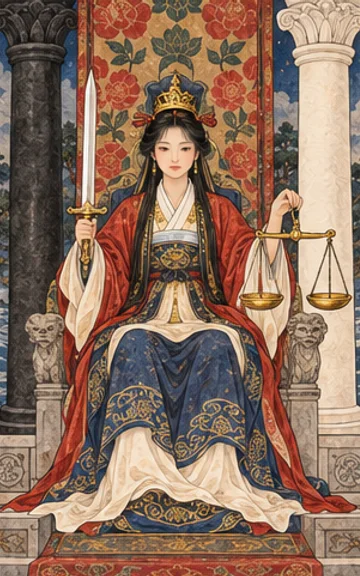
Justice
You reap what you sow under this card, and the outcome tends to be fair. Contracts, judgments and decisions settle the right way when you act honestly.
Be careful of one-sided judgments, hasty conclusions or unfair treatment, whether you are giving it or receiving it.
The card's advice: Check the facts and records before anything else.
Justice: reading the picture
Two straight lines hold this picture together: the sword pointing up and the scale beam lying flat. The woman on the throne grips the sword in one hand, lets the scales hang from the other, and looks straight at you. Unlike blindfolded courthouse statues, her eyes are open. She isn't fair by refusing to look; she's fair after seeing everything. She wears hanbok, traditional Korean dress, and a gold crown trailing red ribbons. One pillar is black, one white, and stone guardians sit at each side, like the haetae, a lion-like creature set at Korean palace gates and said to tell right from wrong. The two pans hang level.
Justice in love, work and money
- Love and relationships
You may honestly ask yourself whether the give and take of feelings is balanced. If only one of you is trying, talk it through calmly instead of storing up hurt, and work toward fairness.
- Work and study
Effort gets its proper credit now, so if you've been diligent, you can hope for a good result. Read contracts and documents carefully, and base decisions on facts, not feelings.
- Money
It's a good time to settle overdue accounts, like money lent or borrowed and costs you agreed to split. Keeping receipts and records helps prevent misunderstandings later on.
The security deposit that came back short
A 27-year-old renter opened the refund from her old landlord and found $640 missing, with a vague line about cleaning and repairs. She was halfway through an angry email when she drew Justice, and the level pans stopped her. She pulled up her move-in photos. They did show the walls were already scuffed. They also showed a clean carpet, which meant the wine stain by the couch was hers. Her rewritten email owned the stain, asked for an itemized list for everything else, and stayed polite. Arguing from the full record felt steadier than arguing from anger.
Questions to ask yourself after drawing Justice
- Which fact in this situation works against you, and have you put it on the scale yet?
- Is this a moment for the sword, a clean cut and a firm no, or for the scales, a slower weighing of both sides?
- If someone who doesn't much like you read your account of what happened, which part would they say you left out?
Justice as a yes or no
Maybe Since you reap what you sow here, the answer will be a fair reflection of what you've put in.
Easy to confuse with King of Swords
Both show a crowned figure on a throne holding a sword straight up, so they get swapped. The King of Swords is about a person whose decisions run on logic and principle. Justice adds the scales, shifting the focus from character to outcome. Ask who is deciding and you're with the King; ask whether the result will be fair and you're with Justice.
A common misreading of Justice
Many people hear Justice as "I'm right, so I'll win." The scales don't take the asker's side. The card says results will match what was actually done, and that includes your own missteps if there were any. In a dispute, it's a prompt to audit your part first.
Symbols in Justice
The figure enthroned between two pillars represents judgment that favors neither side, and the upright sword in the right hand is the decisiveness that separates right from wrong. The scales in the left hand weigh both sides evenly, while the crown and red robe show the responsibility and power to act that come with judgment.
How we drew Justice
- Kept from the 1909 card
the throne between two pillars, the upright sword in the right hand, the scales in the left hand, the crown, the red robe
- What we changed
Justice wears hanbok, the pillars form a black and white pair, and stone guardian beasts sit on either side of the throne.