King of Swords
The King of Swords makes decisions by logic and firm principle. His expert, even-handed judgment earns the trust of the people who depend on him.
You may become overly rigid, or lean too hard on your authority instead of truly listening to others.
The card's advice: Keep your principles, but see the people too.
King of Swords: reading the picture
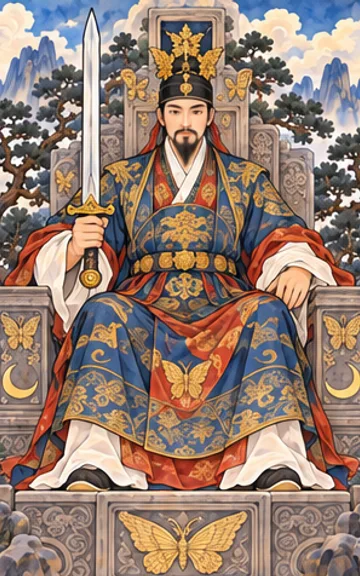
He looks straight at you. Dressed in a gonryongpo, the embroidered robe worn by Korean kings, and a tall black hat with a gold ornament, he faces the viewer head-on, unlike the page and knight, who gaze off into the distance. A round gold dragon is stitched on his chest. One hand holds the sword vertical, tip to the sky; the other rests easily on his knee. Gold butterflies and crescent moons alternate on the stone throne, light winged things carved into hard rock: firm principles without a frozen mind. Gnarled pines and far mountains behind him add the weight of someone who has weathered a great deal.
King of Swords in love, work and money
- Love and relationships
With reason running ahead of feeling, romance may seem a little stiff right now. Your reliability in keeping promises is a great strength, so sometimes set judgment aside and ask how your partner feels first.
- Work and study
Making decisions by principle and logic wins you trust now. Expertise or credentials work in your favor, and following the rules while weighing people's circumstances earns you more respect as a leader.
- Money
Reading contracts and terms carefully is what protects your resources. Do not decide big money matters on a hunch; hear from a qualified professional and keep everything in writing.
A friend's resume on the hiring panel
A 49-year-old engineering director was on a hiring panel when a familiar name came up: a college friend who'd been out of work for eight months. The other panelists barely knew the candidate; he knew him well. He drew the King of Swords, the ruler who looks straight ahead, and read it as doing the fair thing in the open. He told HR about the friendship, stepped back from scoring that candidate, and let the panel's written criteria do the work. Whatever the outcome, nobody could question it later.
Questions to ask yourself after drawing King of Swords
- Explaining this decision face to face to everyone it affects, which part would be hardest to say?
- Where are you tempted to bend the rule a little because the person is close to you?
- Who would challenge your reasoning head-on, and what would they point at first?
King of Swords as a yes or no
Yes Your standards are clear and your judgment is fair, so moving step by step by the rules works well.
Easy to confuse with The Emperor
Both kings sit on stone thrones radiating authority. The Emperor's power comes from order and structure: he sets the rules and guards the territory. The King of Swords draws on judgment and knowledge: he can explain why something is right and persuade others of it. The Emperor decides what we'll do; the King of Swords tells you why. Think CEO versus general counsel.
Symbols in King of Swords
The king faces straight ahead, holding his sword upright, a sign of judgment that leans to neither side. The butterflies and crescent moons on his throne stand for shifting thought and intuition.
How we drew King of Swords
- Kept from the 1909 card
the king facing forward with his sword held upright, the throne with butterfly and crescent moon designs
- What we changed
The king wears a gonryongpo (a Korean king's dragon robe).