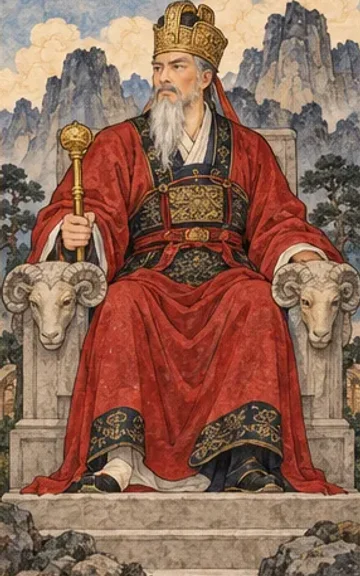
The Emperor
This card carries the steady power to set clear standards and lead others well. Right now, careful plans and firm principles are what turn your efforts into lasting results.
Too much stubbornness and control can drive people away. Avoid pushing others down with force.
The card's advice: Keep the rules firm and your words gentle.
The Emperor: reading the picture
Carved ram heads stare straight out from the arms of a stone throne. Between them sits a white-bearded king in a red robe cut in the style of Korea's old royal court, gold crown on his head, posture square: knees apart, nothing leaning. Both feet are planted on a stone step. His right hand grips a gold scepter upright; his left rests on a ram's head. Nearly everything around him is stone and hard edges, from the steps to the jagged peaks behind. This seat was built to hold, not to comfort. A ram leads its flock from the front, so a hand on its head reads as drive kept under control.
The Emperor in love, work and money
- Love and relationships
Clear commitments and a sense of responsibility help the bond settle into something dependable. If you insist on doing everything your way, your partner may feel boxed in, so make big decisions together.
- Work and study
Set up a system and divide the roles, and scattered tasks fall neatly into place. You may be asked to lead; hold to your principles but listen to people, and they'll follow you longer.
- Money
A budget and careful tracking of fixed costs make your household finances sturdier. Handling money by set rules rather than by mood becomes your most reliable support.
Three roommates and no chore chart
Rent had gone out late twice, and the sink hadn't been empty since August. A 26-year-old who'd signed the lease with two college friends kept hoping things would sort themselves out, because setting rules felt like it might ruin the friendship. He drew The Emperor and kept staring at the king's feet, planted on that stone step. What the apartment lacked wasn't strictness; it was a floor everyone could stand on. He wrote one page: rent due by the 1st, a rotating dish week, quiet hours on weeknights. He brought pizza to the meeting where they read it together.
Questions to ask yourself after drawing The Emperor
- Where at work or home are you waiting for people to just figure it out, when one written rule would spare everyone?
- Is the ram under your hand someone else, or your own urge to charge ahead?
- Has any corner of your life turned so rocky and rule-bound that people have stopped approaching?
The Emperor as a yes or no
Yes Plans and principles create results with this card, so if your groundwork is solid, things tilt toward yes.
Easy to confuse with The Hierophant
A throne, a tall gold staff, an older man with a white beard: at a glance they could be the same person. The Emperor's power is to decide, writing the rules and owning the result. The Hierophant's power is to pass on, handing existing teaching to two students who came to learn. One writes the rulebook; the other opens a book that already exists.
A common misreading of The Emperor
It's often read as pointing to a specific man, like a father or a male boss. The tradition cares more about the role than the gender: whoever sets order and carries responsibility, and that can be you. In a work question, first ask whether you're the one who needs to put structure in place.
Symbols in The Emperor
The stone throne carved with rams' heads stands for an unshakable will and the drive to lead from the front, while the red robe shows active power and passion. The bare, rugged mountains behind him reveal a firm foundation and an order that holds even in harsh conditions.
How we drew The Emperor
- Kept from the 1909 card
the stone throne with rams' heads, the red robe, the rocky mountains behind
- What we changed
His clothing recalls the red robes once worn by Korean kings.