Nine of Swords
This card shows worry chasing worry through a long, sleepless night. Most of those fears look much bigger in the dark than they really are.
The worry starts to settle, and you find yourself ready to reach out for support.
The card's advice: Write your worries down and keep only what you can act on.
Nine of Swords: reading the picture
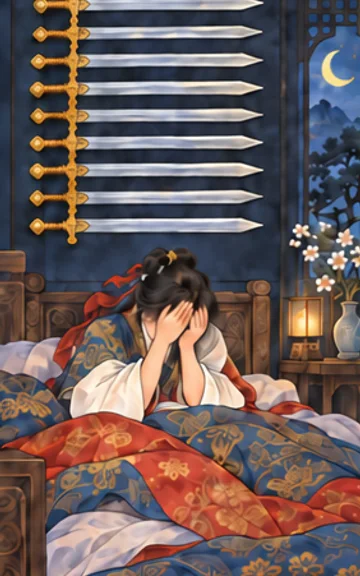
Most people miss the lamp. Their eyes go straight to the figure sitting up in bed with both hands over the face, and to the nine swords stacked across the dark blue wall above. The swords lie flat in neat rows, hilts lined up on one side, like ruled lines on a page, one anxious thought after another. A patterned quilt in red and blue covers the bed. Through a latticed window of the kind found in a hanok, a traditional Korean house, a crescent moon hangs beside a pine. On the table stand a vase of white flowers and a lit lamp. The room isn't fully dark; light is within reach.
Nine of Swords in love, work and money
- Love and relationships
Fears that your partner might leave or has misunderstood you may keep you up at night. Sharing what is on your mind usually clears things up faster than letting your imagination run wild alone.
- Work and study
A single mistake may replay in your head all night, but the next morning there is often a way to fix it. List your worries and sort them into what you can do now and what can wait.
- Money
When credit card bills or debt make you anxious, looking clearly at the exact numbers can actually calm you. If it feels overwhelming, talk to someone you trust or a public or nonprofit counseling service instead of struggling alone.
Replaying the best-man toast at 3 a.m.
A 41-year-old gave the best-man speech at his younger brother's wedding on Saturday. By 3 a.m. Sunday he was wide awake, replaying one joke about the groom's college days that got a laugh from half the room and silence from the other half. He drew the Nine of Swords. It said nothing about whether the joke had ruined anything. It pointed out that the torment was the replay, not the reception. He got up, drank a glass of water, and wrote his brother a short text to send at a reasonable hour: if that joke landed wrong, I'm sorry.
Questions to ask yourself after drawing Nine of Swords
- Is the scene playing on repeat tonight something that already happened, or something that hasn't happened yet?
- Would this same worry weigh as much if you looked at it at noon over coffee?
- What is the lamp within arm's reach right now: a person, a habit, or a fact you can check?
Nine of Swords as a yes or no
No Choices made in anxiety tend to waver, so sleep on it and think again tomorrow.
Easy to confuse with The Moon
Night, worry and moonlight overlap, so this one pairs with The Moon. The Moon is uncertainty outside you: a murky path, things that may not be what they seem. The Nine is noise inside your head, in a quiet room with the lamp on. If you're anxious because you lack information, think Moon. If you have the facts and still can't let go, think Nine.
A common misreading of Nine of Swords
Some take the Nine as a warning that something bad is about to happen. The card pictures a mind before an event, not the event itself. It can't tell you what will occur. What it can do is help separate thoughts that grew at night from facts you can check in daylight.
Symbols in Nine of Swords
A figure sits up in bed in the dark, face buried in hands, while nine swords hang in rows on the wall behind. The swords never touch the body, showing how worry grows larger in the mind than in real life.
How we drew Nine of Swords
- Kept from the 1909 card
the figure sitting up in bed at night with face in hands, nine swords on the dark wall
- What we changed
The bedding and room are those of a hanok (a traditional Korean house).