Ten of Swords
The Ten of Swords marks a low point that cannot get any worse. Like the dawn glowing on the far horizon, the only direction left from here is up.
The hardest stretch is finally behind you, and slow, steady recovery is beginning to take hold.
The card's advice: Accept that what has ended is truly over.
Ten of Swords: reading the picture
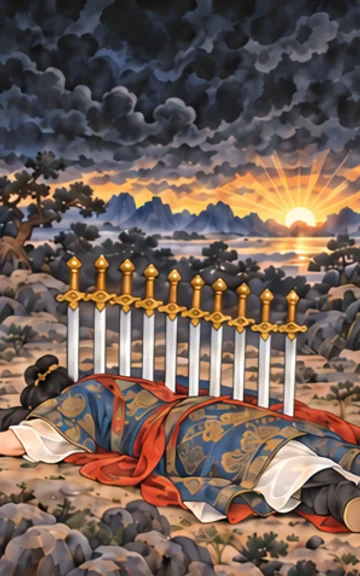
Black clouds press down on almost the entire sky. Beneath them a man lies face down on rocky ground, his blue hanbok, Korean traditional clothing, spread around him, ten swords planted in a row along his back like a line of grave markers. One sword would have been enough; ten is deliberate exaggeration, an ending drawn so completely that nothing worse can follow. Now look just above him. Between the clouds and the land, a band of orange glows, and a half-risen sun between distant peaks throws rays across still water. With his face to the ground, he can't see it. You can, from outside the frame.
Ten of Swords in love, work and money
- Love and relationships
If a relationship can no longer be held together, accepting that it has ended is the first step toward healing. A heart that has hit bottom can only rise from here, so go easy on blaming yourself.
- Work and study
Even if a project collapsed or feels like a major failure, the worst moment is already passing. Wrap up what needs closing neatly and prepare, slowly, for a fresh start.
- Money
If you have taken a loss, stop before it grows and focus on protecting what remains. Knowing where the bottom is also gives you a clear baseline to build from again.
The badge that stopped working
After nine years at a logistics company, a 46-year-old operations analyst found out about the layoff when his badge blinked red at the door. The email was waiting in his personal inbox. He drew the Ten of Swords that night and thought, of course. But the card isn't there to pile on. Ten swords leave no room for an eleventh; the worst part has already happened, and the effort he'd spent dreading cuts can go somewhere else. Before bed he wrote down three things worth keeping from those nine years: a mentor, a skill, a friend in accounting.
Questions to ask yourself after drawing Ten of Swords
- Has the worst part already happened, the part that can't get worse from here?
- Lift your face off the ground for a moment: what's on the horizon?
- From this ending, what one thing do you want to carry into whatever comes after?
Ten of Swords as a yes or no
No This matter has already reached its end, so finding a new path beats clinging to the old one.
Easy to confuse with Death
Both speak of endings. Death is a turning of seasons, one thing closing as another opens, an ending that reaches everyone in its time. The Ten leans less on transition and more on hitting bottom: a mind worn out by thoughts and words, exhaustion that can't hold on. Ask whether the story is turning a page, or whether this page simply hurt.
A common misreading of Ten of Swords
The swords in the back make people fear betrayal or a literal accident. Traditionally the Ten describes a mind reaching rock bottom, not a forecast of events. Often nobody stabbed anyone; the person simply wore out. If the weight feels like too much, lean on people around you or a counselor.
Symbols in Ten of Swords
A man lies face down with ten swords in his back, the picture of an ending that cannot get worse. Yet beneath the black sky, a yellow dawn spreads along the distant horizon over calm water, promising that night gives way to day.
How we drew Ten of Swords
- Kept from the 1909 card
the fallen figure face down with ten swords in his back, the dawn light at the edge of a black sky
- What we changed
The fallen figure is dressed in hanbok (traditional Korean clothing).